
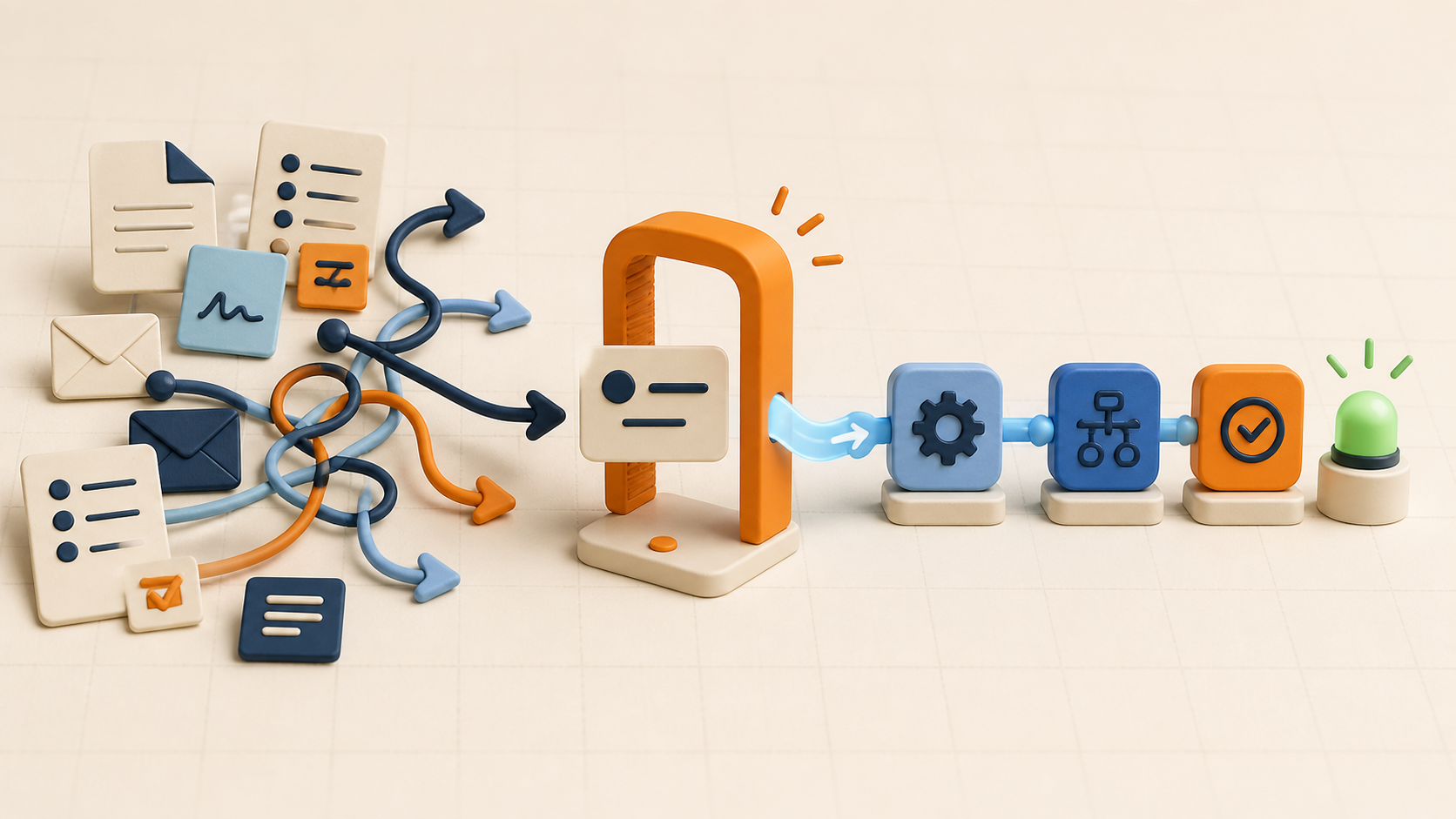
When a business has several slow, manual workflows, the temptation is to automate the most frustrating one or buy a platform that promises to fix everything. Neither is a reliable way to choose a first project. Frustration shows that a problem exists, but not whether it is suitable for automation or likely to produce a useful return.
A strong first automation sits at the intersection of value, clarity, and manageable risk. It removes enough repetitive work to matter, follows rules the team can explain, and can be introduced without rebuilding the entire operation. The framework below helps you find that opportunity and turn it into a focused pilot.
Begin with the process, not the technology
Start by describing what happens today from trigger to outcome. Record who performs each step, which systems they use, where information is copied, and what happens when something goes wrong. Include the unofficial spreadsheet, inbox, or checklist that keeps the process moving; these workarounds often reveal the best opportunity.
Keep product names and AI features out of the discussion at first. A clear process map lets you decide whether the answer is automation, a better integration, a small custom tool, or simply removing an unnecessary step.
Look for the traits of a good first candidate
The most promising candidates are frequent, repeatable, and based on reasonably stable rules. They consume measurable time or create a visible delay, yet their exceptions can still be recognised and passed to a person.
Invoice reminders, enquiry routing, document preparation, approval handovers, booking confirmations, and recurring reports often fit this pattern. A rare process that relies on judgement and changes every time is less suitable, even if each individual case feels painful.
- It happens often and follows a recognisable sequence.
- The required information is available and reasonably consistent.
- A person can explain the normal rules and important exceptions.
- Improvement can be measured in time, errors, speed, or customer experience.
Score value, feasibility, and risk
Create a shortlist and score each process from one to five across three areas. Value covers staff time, avoided errors, faster service, and commercial impact. Feasibility covers data quality, rule clarity, system access, and the effort required. Risk covers the consequence of a mistake, security and compliance concerns, and how difficult the change would be to reverse.
The best first project usually has high value, high feasibility, and low or controllable risk. The score is not a business case on its own; it makes assumptions visible so operations, management, and technical teams can challenge them together.
Measure the current baseline
Before changing anything, observe a representative sample. Measure how many cases arrive, how long active work takes, how long customers or colleagues wait, how often rework is needed, and how many exceptions occur. Estimates are useful for narrowing the list, but a short period of real measurement gives the pilot a credible starting point.
Choose one primary success measure and a few safeguards. For example, the aim might be to reduce handling time by 40 percent while keeping error rates stable and ensuring every exception reaches a named owner.
Define the smallest useful version
A first version should automate one complete, valuable slice of the workflow. It might capture a form, validate the information, create a record in the right system, and notify an owner. It does not need to handle every historical edge case or replace every tool on day one.
Draw a clear boundary around the pilot: which team, customer type, region, or transaction it covers; which systems it may change; and which decisions remain with people. A narrow boundary makes testing safer and results easier to interpret.
- State the trigger and successful end point.
- List the normal rules separately from exceptions.
- Give every exception a visible human route.
- Keep a manual fallback during the pilot.
Design human control into the workflow
Automation should make responsibility clearer, not hide it. Give the team a way to review status, correct information, retry failed actions, and understand why a rule produced an outcome. Record important changes so problems can be investigated without reconstructing events from several inboxes.
This matters even more when AI is involved. Use it first for bounded tasks such as classifying, extracting, or drafting, then require review where ambiguity or consequence is high. Confidence thresholds and escalation routes are part of the product, not optional extras.
Run the pilot and compare the result
Release to a small group, watch real cases move through the workflow, and review failures quickly. Compare the same measures you captured at baseline, including the time spent supervising the automation. A process is not improved if visible admin disappears but staff must constantly rescue it behind the scenes.
Speak to the people doing the work as well as the people waiting for its outcome. Faster processing is valuable, but clearer ownership, fewer interruptions, and more predictable customer communication may be equally important results.
Expand only after the first workflow is dependable
Once the pilot consistently meets its target, decide whether to extend its coverage, connect another system, or move to the next candidate. Reuse what worked—data definitions, monitoring, permissions, and exception patterns—rather than copying the automation without its controls.
A successful first project creates more than saved time. It gives the business evidence about its processes, systems, and capacity for change. That evidence is the foundation of a sensible automation roadmap.
The takeaway
Choose the first process by evidence: meaningful value, clear rules, accessible data, manageable exceptions, and an outcome you can measure. Then automate the smallest version that is genuinely useful and keep people in control of anything unusual or consequential.
The aim is not to prove that automation is possible. It is to prove that one workflow can become faster, calmer, and more reliable—and to learn enough to make the next decision with confidence.